Governor’s rural health care plan touts new medical school and Hope Centers as a cure for doctor shortage while critics warn of short-term federal money and long-term state costs
LEWES, Del. — Gov. Matt Meyer is pitching a billion-dollar federal health care package as a “stable future” for rural Delaware, but healthcare advocates warn the plan could deepen the state’s dependence on Washington while failing to fix the immediate doctor shortage in Kent and Sussex counties.
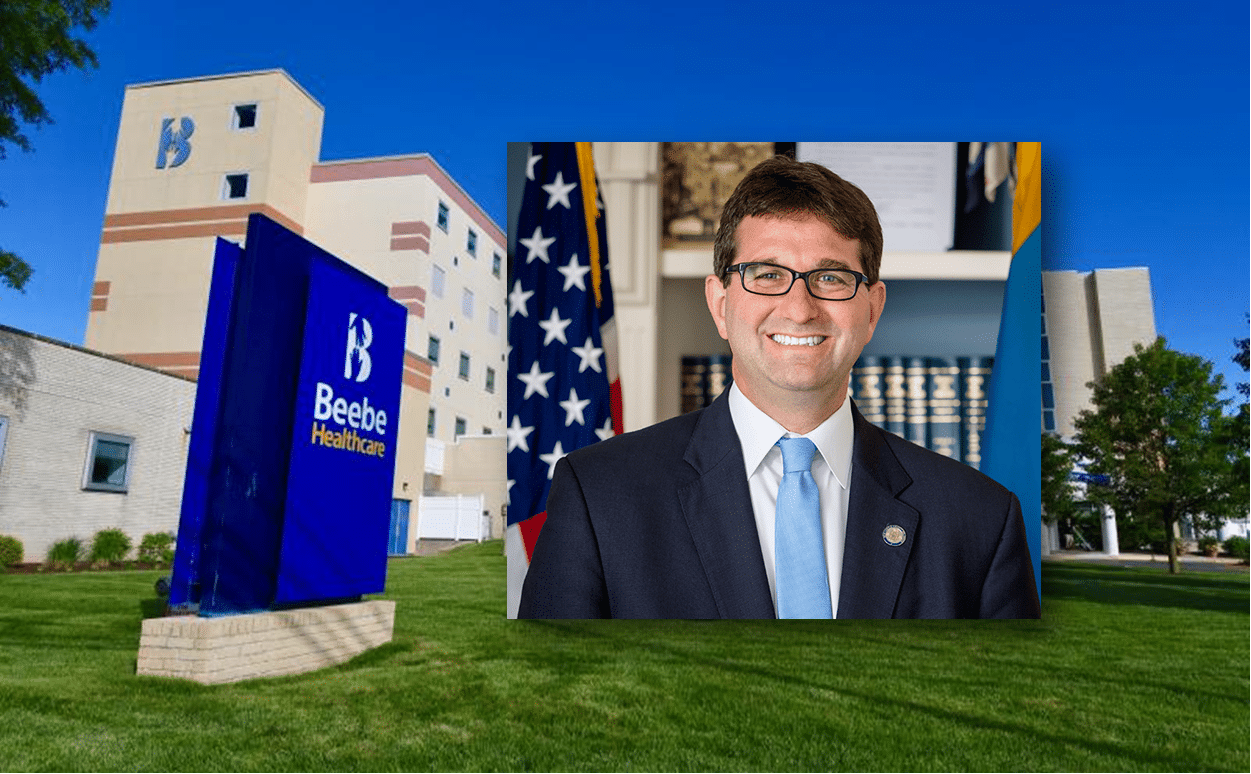
Speaking at Beebe Healthcare in Lewes, Meyer said Delaware has applied for up to $1 billion from the new federal Rural Health Transformation Program, part of the “One Big Beautiful Bill” that paired major Medicaid cuts with a $50 billion rural health fund. He framed the proposal around three “North Stars”: expanding access, lowering costs, and improving health outcomes.
If Delaware’s plan is approved, the state expects to receive at least $500 million by formula over five years and potentially as much as $1 billion, depending on how federal officials rank its application. Half of the national fund is split evenly among participating states; the rest is awarded competitively by the Centers for Medicare & Medicaid Services.
Under the plan outlined by Meyer and state health officials, the new federal dollars would be aimed squarely at Kent and Sussex counties, where families routinely struggle to get appointments with a primary care doctor. Key projects include Delaware’s first medical school — developed with an out-of-state partner but built around clinical training sites in Kent and Sussex — two “Hope Centers” that would serve as community health hubs in each county, and hospital technology upgrades to streamline care and reduce administrative costs.
Meyer argued that the investment would help reverse years of decline in access to basic care. Recent analyses have ranked Delaware near the bottom nationally in meeting residents’ primary care needs, with especially sharp gaps in rural communities.
Healthcare policy advocates and budget analysts are not questioning that downstate residents need better access to doctors. Their concern is what happens when the federal money runs out. The Rural Health Transformation Program is funded for just five years. That money was added late in the legislative process as a political compromise to soften the impact of long-term Medicaid cuts.
From a financial perspective, that raises several questions for Kent and Sussex counties: whether Delaware is building permanent obligations on temporary money; whether future tax or fee increases will be needed to sustain new programs; and how much control over rural health care will shift from local providers and state officials to federal regulators in Washington, said Jane Brady, former Attorney General and Chair of A Better Delaware an non-partisian advocacy group.
Meyer acknowledged at Beebe that Delaware is unlikely to get the full $1 billion and said his administration would “do anything we can” to secure the largest possible award, adding that officials would “cross that bridge” later if the grant falls short. Critics say that sounds less like a backup plan and more like a wait-and-see approach with billions at stake.
A central selling point of the state’s application is a pledge to overhaul Delaware’s certificate of need rules — the regulatory process that limits where hospitals, surgical centers and specialty clinics can expand or open. Many health care reformers, including Dr. Christopher Casscells, have long argued that such laws stifle competition, protect incumbents and drive up prices by making it harder for new providers to enter underserved markets. Several neighboring states have scaled back or eliminated their programs.
Meyer and legislative leaders have promised to “reform” the system, particularly for rural areas. However, so far, they have not publicly committed to a full repeal, and details such as how much new hospital or clinic capacity would actually be allowed in Kent and Sussex remain unclear. As long-time opponents of the Certificate of Need rules, partial tweaks risk appearing as a box-checking exercise designed to please federal reviewers rather than a genuine free-market shake-up.
Downstate residents already know that finding a family doctor can mean months on a waiting list or a long drive to another county. The centerpiece of Meyer’s pitch — a new medical school — could eventually help, but it will not solve near-term access problems. Training new physicians takes years, and without competitive pay and a better business climate for small practices, newly trained doctors may still leave for neighboring states. The plan has not yet spelled out how many residency slots would be reserved in Kent and Sussex or what incentives will keep graduates in rural Delaware.
Casscell’s also argued that, alongside long-range ideas like a medical school, the state should be moving faster on short-term steps that do not rely on new federal grants, such as easing regulatory burdens on independent practices, expanding scope-of-practice for nurse practitioners and physician assistants, and addressing low reimbursement rates that make it hard for primary care offices to survive in rural markets.
The proposed Hope Centers in Kent and Sussex would bring primary care, behavioral health, and social-service navigation together under one roof, targeting patients who often fall through the cracks. Supporters see them as a way to coordinate care better and reduce emergency room overuse. Brady worries that the new Hope Centers may duplicate services already offered by community health clinics, faith-based nonprofits, and private practices, and whether they will crowd out existing providers instead of partnering with them.
The plan also calls for major hospital information technology and “backend” upgrades. Those investments may make sense in a system that still relies on outdated systems, but big government-backed technology projects have a mixed track record. When they run over budget, taxpayers and patients are often left holding the bill.
At the Beebe event, Meyer repeatedly framed the Rural Health Transformation money as a once-in-a-generation chance to shore up Kent and Sussex health care. He said the federal funding would help “build a stable future” for the state’s rural health infrastructure and returned several times to his three priorities: expanding access, cutting costs, and improving outcomes. He also pointed to Delaware’s last-in-the-nation standing for primary care access as justification for the aggressive bid, calling the situation unacceptable.
For many families in Kent and Sussex counties, the bottom line will be simple: whether they can get a timely appointment with a doctor close to home. From a conservative standpoint, Meyer’s billion-dollar ask may be a necessary stopgap — but it also raises the question of whether Delaware is fixing the foundations of rural health care or simply building new programs on top of an already fragile system.