

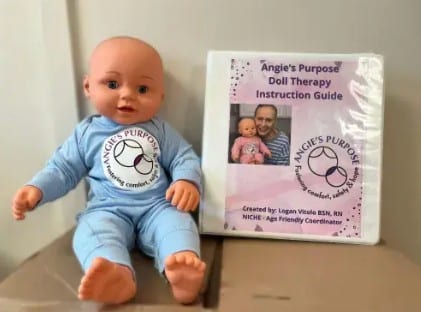
Beebe’s Doll Therapy Program gives realistic baby dolls and accessories to patients with memory loss, offering a calming, non-medication-based way to ease dementia-related behaviors. (Photo courtesy of Beebe Healthcare.)
Beebe’s Doll Therapy Program Offers New Support for Patients With Memory Loss
When a patient with dementia arrives at the hospital, the top priority is addressing the medical issue that brought them there. But the experience of hospitalization can intensify confusion or anxiety for many. At Beebe Healthcare, a new initiative is providing an unexpected source of comfort: baby dolls.
Beebe’s Doll Therapy Program, launched in January 2025, places realistic baby dolls into the arms of patients diagnosed with memory loss. Each patient receives a doll, clothing, blanket, and bottle, which they are encouraged to keep after discharge. The dolls serve as a non-pharmacologic, person-centered intervention for dementia-related behaviors, and this has already shown strong and measurable results.
“The dolls provide patients with a sense of purpose and comfort. They feel like they need to take care of it, which shifts their thinking,” said Logan Jarrell, BSN, RN, NICHE (Nurses Improving Care for Healthsystems Elders) Coordinator at Beebe.
RELATED STORY: Delaware’s Aging Boom Puts Adult Caregivers at the Center of Difficult Decisions
For Jarrell, the program grows out of both research and personal experience. Before becoming NICHE coordinator, she worked as a bedside nurse and noticed the lack of diversional activities for older adults.
“I was working as a bedside nurse prior to this. My passion has always been the elderly. I saw first-hand how frustrating it was that we did not have diversional activities available on the unit,” Jarrell said. “So when a patient does start acting out or even just gets bored, we didn’t have anything to give them. We had volunteers going around with an activity card but they’re only there certain hours of day. This made things very difficult.”

Her inspiration for the idea goes back to her earliest experiences in care settings.
“I remembered back in nursery school, especially when we went to skilled nursing facilities that had memory care units, you would see a lot of older adults with baby dolls and stuffed animals and I thought it would be interesting if we could get that in a hospital,” she said.
Building the Program

The doll therapy initiative grew out of another project Jarrell launched six months earlier: Therapeutic Activity Kits. These kits, designed for dementia patients across Beebe, contain diversional activities and detailed instructions staff can use when patients show signs of distress or restlessness. While researching additional tools for the kits, Jarrell revisited doll therapy—an approach supported by evidence showing that dolls can reduce anxiety and provide a meaningful focus for people with dementia.
“In January 2025, I initiated the Doll Therapy Program at Beebe Healthcare as an extension of the Therapeutic Activity Kits initiative I began six months earlier,” she said. “The Therapeutic Activity Kits were developed to provide readily available diversional activities for dementia patients on the nursing units, ensuring staff had accessible tools and an accompanying instruction guide to identify appropriate activities for various situations.”
Jarrell said she recalled how dementia patients in care facilities responded positively to doll therapy during her nursing school clinical rotations, and wondered how it might work in an acute-care hospital setting.
Beebe partnered with Angie’s Purpose and received donor support through the Beebe Medical Foundation to launch the program. But getting it off the ground required navigating logistical hurdles.
“Implementing the program presented several challenges, including securing staff buy-in, identifying appropriate storage for the dolls, developing educational materials, and determining the best methods to adapt this intervention to an acute care hospital setting, where evidence and research are limited,” Jarrell said.
Still, she said, “the program has laid important groundwork for enhancing person-centered dementia care within the hospital environment.”
90 Patients, 89 Safety Successes
Since January 2025, the program has tracked 90 patients who received dolls. According to Jarrell, the impact has been huge.
“We’ve seen fantastic results since implementing this,” she said. “We started the program in January 2025 and to date we’ve had 85 patients throughout the whole hospital who have been given the dolls. Out of those patients, all but one did not have a physical workplace violent event, wasn’t placed in restraints, or didn’t have a fall for the rest of their hospitalization.”
A later update increased the number to 90 patients, with 89 remaining “incidence-free” after receiving a doll.
These numbers matter, Jarrell noted, because they speak directly to safety and patient well-being—two of the biggest challenges in caring for individuals with dementia in hospitals. She added that the program has also impacted internal culture.
“The program has also helped reshape the nurses’ way of thinking,” she said. “In the past, people felt it was easier to medicate the patient when you can actually just give them something to do.”
 A Wider Educational Mission
Although Jarrell is the only NICHE coordinator, she has worked to make sure the program is accessible to all staff, regardless of department or shift.
She works very closely with case management team so they all have access to this resource guide that she’s created. “All Beebe employees have access to that: nurse managers, community health workers,” she said. “Although there is only one of me, I make these resources readily available so that when I’m not there, it can be utilized.”
Beebe’s intranet now houses more than 100 resources for senior care. Jarrell brings these materials to outpatient sites, health fairs, and community events, and said she is working toward a public version so families can access the information at home.
She said NICHE’s structure makes education a core component.
“NICHE is also an education program, so I have certified geriatric nurses throughout the hospital who are very well-aware of the resources so they know to advocate for these resources and diversional activities,” she said. “I also try to go to as many staff meetings as I can to educate. I try to get out there as much as I can and talk to as many people as possible to spread awareness.”
Challenges Seniors Face
Jarrell said one of the biggest barriers families encounter is acknowledging when a loved one needs help.
“A lot of people I work with struggle to admit they need help because they feel like it’s a sign of weakness when it’s really not,” she said.
She added that people don’t always know where to start or what resources exist. Patients entering the hospital are often dealing with an acute medical issue, not thinking about longer-term planning.
“That’s why I really try to harp on pre-planning,” she said, describing situations in which caregiving arrangements can change unexpectedly. Her goal is to make sure seniors and caregivers know what support is available before a crisis happens.
Family Response: “Overwhelmingly Positive”
For Jarrell, feedback is a crucial piece of the program. Staff record each use of doll therapy—what behaviors were present before, how the patient responded, and any additional observations. Jarrell also conducts rounds to see the effects firsthand.
Families often witness the interventions and frequently share their perspectives.
“Families are often present and consistently share positive feedback,” she said. “Many express appreciation that the dolls are not solely for hospital use—the dolls are gifted to patients to keep after discharge, which helps maintain continuity of comfort and familiarity at home or in long-term care settings.”
All feedback is collected in a database, reviewed monthly, and shared with leadership teams.
“The ongoing feedback loop has been instrumental in refining the program and reinforcing staff engagement through visible, meaningful outcomes,” she said.
A Regional Ripple Effect
Beebe’s program is already inspiring others.
“Two of our post-acute facilities (Excelcare & Ocean Grove) have now signed on with the same doll therapy program,” Jarrell said. “One of them is even making a nursery for the baby dolls in their memory care unit.”
Christiana Hospital has expressed interest as well, and Bayhealth has reached out about learning from Beebe’s outcomes.
“It is incredibly rewarding to see this initiative extend its influence beyond our hospital walls,” she said. “Knowing that the program will soon bring comfort and meaningful engagement to residents across Sussex County reinforces the broader value of non-pharmacological, person-centered dementia care.”
Technology and Future Tools
While doll therapy may seem simple, Jarrell said technology could also play a key role in diversional activities.
“I do think AI and technology have the ability to help with this,” she said, noting that activity kits include a range of items families can purchase for loved ones—including tech-based tools.
“There are also projectors that project all kinds of different games on to the patient’s bedside table or wall or ceiling and they mimic the patient’s movements,” she said. “What’s great about this is you can use it over and over again.”
Beebe is also exploring dementia education simulations for nursing staff and interactive light-technology programs that promote cognitive stimulation and social interaction.
Looking Ahead
Jarrell hopes the next year brings continued growth—both in patient outcomes and community partnerships.
“Looking ahead, I hope to see Angie’s Purpose and the Doll Therapy Program implemented at Bayhealth and Christiana Care,” she said. She also wants more families to understand how meaningful diversional activities can be at home.
“Ultimately, my goal is to see our program numbers, patient outcomes, and staff and family feedback continue to grow positively, reflecting the sustained value and transformative impact of non-pharmacologic, person-centered dementia care.”
RELATED STORIES:
![Sunrise Seminar to explore the business of protecting important records]()
Sunrise Seminar to explore the business of protecting important records
08/23/2026![Milford schools outpace state with gains in English, math]()
Milford schools outpace state with gains in English, math
08/19/2026![1776 Steakhouse announces plans for second location in Ocean View]()
1776 Steakhouse announces plans for second location in Ocean View
08/19/2026![Meet the Candidates: Bryan Shupe and Patrick Smith seek Republican nomination for Delaware House Dis...]()
Meet the Candidates: Bryan Shupe and Patrick Smith seek Republican nomination for Delaware House Dis...
08/19/2026![Bethany-Fenwick Area Chamber honors local lifeguards at annual awards ceremony]()
Bethany-Fenwick Area Chamber honors local lifeguards at annual awards ceremony
08/18/2026![Rehoboth Beach Main Street and Dogfish Head announce first Downtown Rehoboth Cocktail Week]()
Rehoboth Beach Main Street and Dogfish Head announce first Downtown Rehoboth Cocktail Week
08/18/2026![Lewes Public Library, WHYY to host end-of-summer block party]()
Lewes Public Library, WHYY to host end-of-summer block party
08/13/2026![Downtown Milford Inc. partners with Goodwill for National Thrift Shop Day kickoff]()
Downtown Milford Inc. partners with Goodwill for National Thrift Shop Day kickoff
08/13/2026








Sara Uzer is a journalist from Sussex County with more than 15 years of experience as a writer, editor, and community advocate. She started her career in Washington, DC and has lived in Sussex County for the past five years.
Share this Post