

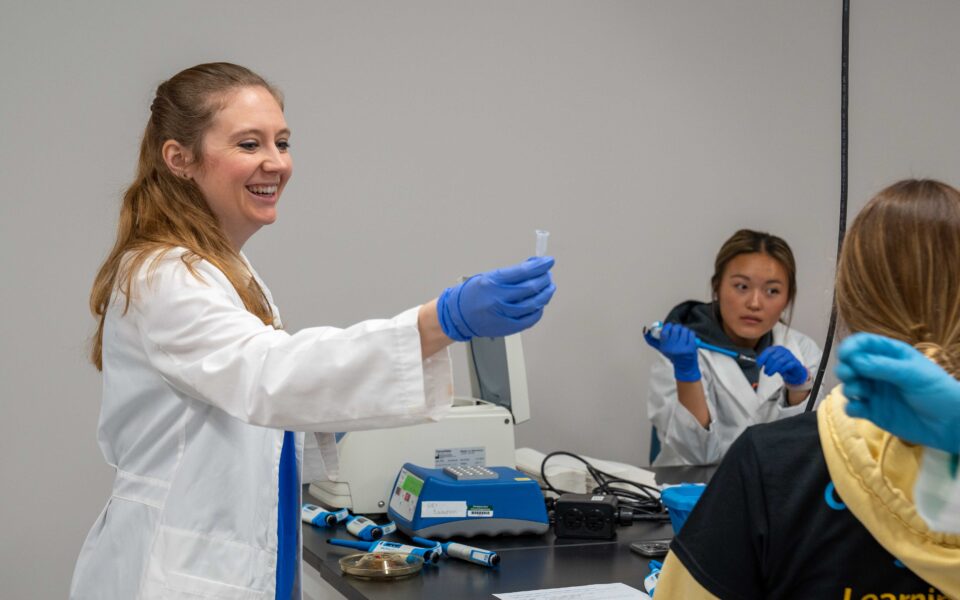
ChristianaCare Gene Editing Institute has received a $500,000 federal grant to expand its Learning Lab program and CRISPR in a Box™, bringing hands-on gene editing experiences to more students in Delaware and beyond. (Photo courtesy of ChristianaCare.)
ChristianaCare Gene Editing Institute has received a $500,000 federal grant to expand its hands-on Learning Lab program, which introduces students to gene editing technology, officials announced.
The funding, secured by Delaware’s congressional delegation, will support the growth of the institute’s Learning Lab and its signature teaching tool, CRISPR in a Box™, allowing more schools across Delaware — and eventually nationwide — to participate.
The program gives high school and college students the opportunity to perform gene editing experiments and observe DNA changes in real time, while also interacting with working scientists and learning about emerging medical technologies.
The Learning Lab currently brings students to the institute for half-day sessions focused on practical, lab-based experience. Officials say the program has already reached thousands of students, with plans to significantly increase participation through the new funding.
“This support helps us give students a chance to see themselves in science,” said Eric Kmiec, executive director and chief scientific officer of the Gene Editing Institute.
“When young people use real tools, work with real scientists and see results with their own eyes, it builds confidence and sparks new interests. We are grateful to our Congressional Delegation for making it possible to expand this life-changing experience.”

The expansion comes as demand grows for workers in science and technology fields, with the program aimed at encouraging students to pursue careers in biotechnology, laboratory science and health care.
RELATED STORY: ChristianaCare Rehabilitation Center in Wilmington Named No. 1 in Delaware by Newsweek
In addition to student programming, the institute plans to increase teacher training, classroom support and curriculum offerings, including lessons focused on data analysis, ethics and the role of gene editing in diseases such as sickle cell disease and cancer.
“CRISPR in a Box™ gives students a way to understand gene editing by doing it themselves,” said Amanda Hewes, education program manager.
“When students try an experiment and watch DNA change, it helps them feel capable. It opens their minds to careers they might not have considered. This grant will help us share that experience with many more students.”
CRISPR in a Box™ grew out of the institute’s research into DNA repair and has gained national recognition as a classroom-ready learning tool. The project previously received support from the National Science Foundation and has been used by thousands of students nationwide.
Members of Delaware’s congressional delegation said the investment will help strengthen the state’s role in scientific innovation.
“Delaware has always been a leader in innovation, and this grant to invest in Delaware’s next generation of innovators will continue that tradition,” said Chris Coons. “I’m proud to have secured this funding so our state can keep putting forward the kind of cutting-edge research that’s happening at ChristianaCare that will change and save lives.”
Lisa Blunt Rochester added, “ChristianaCare’s Gene Editing Institute does amazing work giving our students the tools they need to take on the biomedical challenges of tomorrow.
“I’m grateful that Congressionally Directed Spending has been able to invest in the Learning Lab curriculum and ensure even more students can access these opportunities. This is how we’ll ensure Delaware stays at the forefront of health care innovation for generations to come.”
“Investing in Delaware’s innovative spirit requires strong public-private partnerships,” said Sarah McBride. “I’m proud to support this federal funding to expand access to cutting-edge research and prepare the next generation of scientists to tackle some of the most pressing challenges facing Delawareans.”
Officials said the expanded Learning Lab will continue to focus on increasing access for students who may not otherwise have exposure to advanced STEM opportunities, helping to build pathways to higher education and future careers.
RELATED STORIES:
![Milford schools outpace state with gains in English, math]()
Milford schools outpace state with gains in English, math
08/19/2026![1776 Steakhouse announces plans for second location in Ocean View]()
1776 Steakhouse announces plans for second location in Ocean View
08/19/2026![Meet the Candidates: Bryan Shupe and Patrick Smith seek Republican nomination for Delaware House Dis...]()
Meet the Candidates: Bryan Shupe and Patrick Smith seek Republican nomination for Delaware House Dis...
08/19/2026![Bethany-Fenwick Area Chamber honors local lifeguards at annual awards ceremony]()
Bethany-Fenwick Area Chamber honors local lifeguards at annual awards ceremony
08/18/2026![Rehoboth Beach Main Street and Dogfish Head announce first Downtown Rehoboth Cocktail Week]()
Rehoboth Beach Main Street and Dogfish Head announce first Downtown Rehoboth Cocktail Week
08/18/2026![Lewes Public Library, WHYY to host end-of-summer block party]()
Lewes Public Library, WHYY to host end-of-summer block party
08/13/2026![Downtown Milford Inc. partners with Goodwill for National Thrift Shop Day kickoff]()
Downtown Milford Inc. partners with Goodwill for National Thrift Shop Day kickoff
08/13/2026![Milford Museum’s Hippiefest Returns Aug. 15 at Causey Mansion]()
Milford Museum’s Hippiefest Returns Aug. 15 at Causey Mansion
08/11/2026








Sara Uzer is a journalist from Sussex County with more than 15 years of experience as a writer, editor, and community advocate. She started her career in Washington, DC and has lived in Sussex County for the past five years.
Share this Post